DataShield Commander v3.0.15
Commander: the operations cockpit for coding agents
One tab. Every agent. Commander is where your Claude Code sessions live: launched from a persona with a boot prompt you approved, transcripts kept, and finished work promoted up a dev, test, prod ladder that stops at a dirty tree and asks a human for a reason.
It runs on your box, against your PostgreSQL. Your transcripts are not a feature of somebody else's cloud.
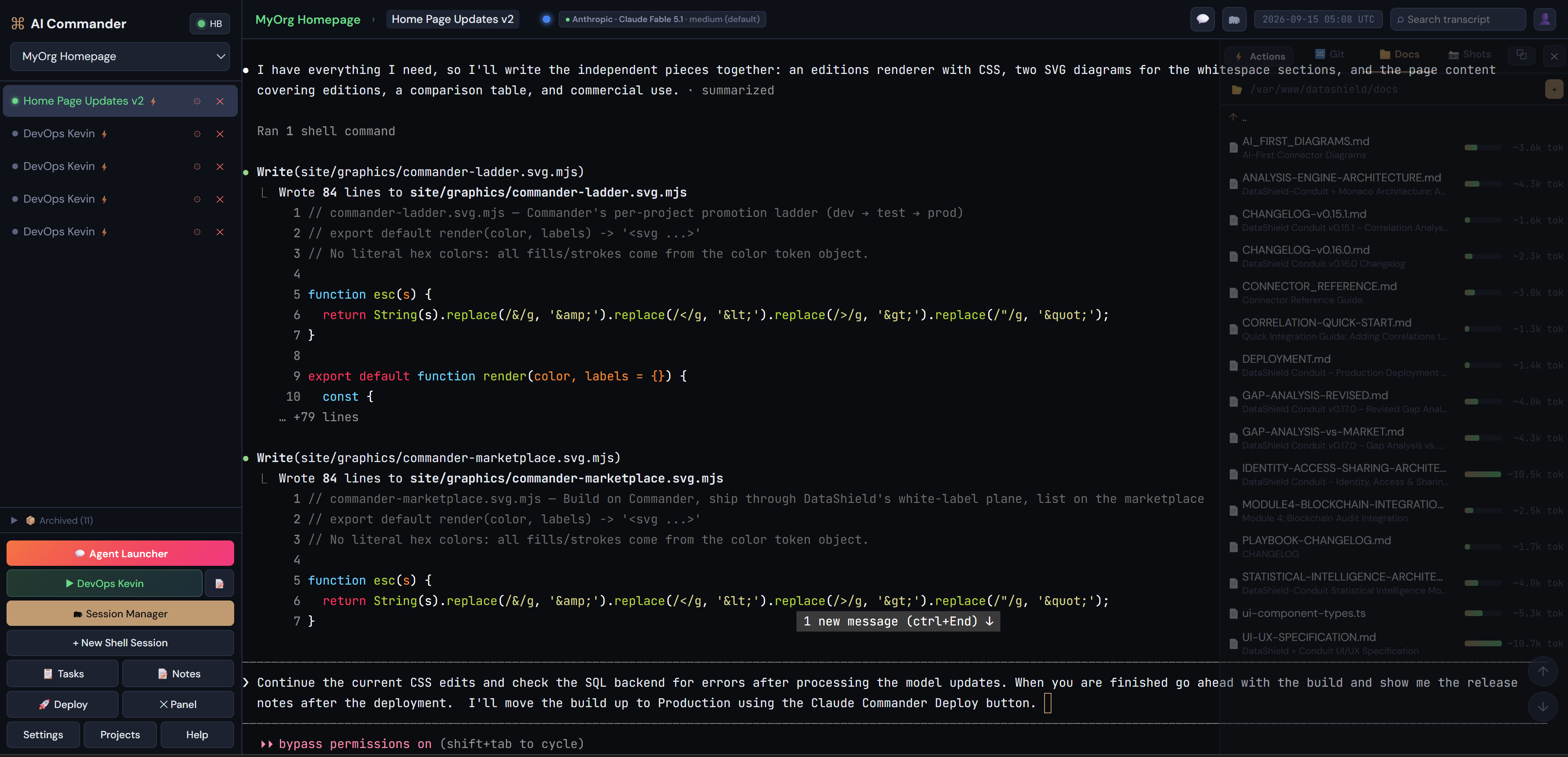
Editions
Same Commander in every box. What changes is how many humans and agents it serves, where it runs, and whether you are allowed to charge other people for what you build on it.
Free
One person, one laptop, finding out what a cockpit is for.
Docker image · your machine
- 1 project, 2 concurrent sessions
- Built-in personas and prompt library
- Bring your own Claude subscription or API key
- Transcripts kept in your own PostgreSQL
- Community support
- Personal, non-commercial use
Personal
One engineer, real projects, more agents than hands.
Docker · or $100 / month on a DataShield-provisioned private server
- Unlimited projects and sessions
- Custom personas and boot prompts
- Promotion ladder with audited override
- Screenshots, artifacts and git tracking
- Attach to daemon sessions, transcript search
- 1 user · internal use
Team
Five people who would like to stop asking "which session did that?" in Slack.
Docker · or $500 / month on a DataShield-provisioned private server
- Everything in Personal, for 5 users
- Sub-agent fleet with nesting blocked
- Several Anthropic accounts, chosen per persona
- Encrypted integrations vault
- MCP servers brokered through Auth
- Deployment history and audit trail
- More seats on request
Enterprise
Companies running agents in production, and anyone selling what they build.
Private air-gapped cloud, your hosting, or ours
- Everything in Team, for your whole organisation
- Commercial use and white-label rights
- SSO with your identity provider
- Signed license plane and fleet state
- Premium features and priority support
- Marketplace listing for your product
Selling anything built on Commander means Enterprise. Agency work included.
Prices are per month, billed monthly, plus applicable tax. Docker editions run on hardware you provide. DataShield-provisioned means a dedicated single-tenant server we operate for you, sized for the edition. Model usage is billed by your model provider, not by us. We are not in the token resale business.
What each edition includes
| Free | Personal | Team | Enterprise | |
|---|---|---|---|---|
| Users | 1 | 1 | 5, more on request | Organisation |
| Projects · concurrent sessions | 1 · 2 | Unlimited | Unlimited | Unlimited |
| Personas and boot prompts | Built-in | Custom | Custom + sub-agent fleet | Custom + sub-agent fleet |
| Promotion ladder | — | ◆ | ◆ with history and audit | ◆ with history and audit |
| Anthropic accounts | 1 | 1 | Several, per persona | Several, per persona |
| Integrations vault · MCP via Auth | — | — | ◆ | ◆ |
| SSO (OIDC) | — | — | — | ◆ |
| Hosting | Docker | Docker or provisioned | Docker or provisioned | Air-gapped, yours, or ours |
| Commercial use and white-label | — | — | — | ◆ |
| Support | Community | Email, next business day | Priority, named contact |
The problem is not the agent. It is the eleventh agent.
One Claude Code session in a terminal is fine. You can see it. You can Ctrl-C it. Ten of them across four repos is a different sport. Terminals hide behind other terminals. Someone asks which session ran the migration and the honest answer is a shrug. The boot prompt that explained how this project works lives in a shell history that got cleared on Tuesday.
Commander is the room where all of that runs. Every session is a tab with a name. Every launch starts from a persona you wrote once. Every transcript lands in a database you own. And when an agent announces that the deploy is done, the promotion ladder is where you find out whether that is true.
Three jobs Commander does every day
Run the fleet
Many Claude Code sessions per project, each a real terminal in the browser, not a chat widget doing an impression of one. Resume a session. Attach to one still running in the Claude Code daemon and pick up mid-thought. Search the logged transcript from the top bar. Model, effort level and account sit in the breadcrumb, so nobody has to ask whose API key is on fire.
Launch with a persona
The Agent Launcher starts a session from a persona: Developer, Tester, Release Manager, DevOps Engineer, Deep Research, or the one you wrote at 2 a.m. and are quietly proud of. A persona carries a boot prompt, a model and effort setting, skill packs and MCP bindings. Personas double as a sub-agent roster, with nesting blocked. An orchestrator cannot spawn orchestrators. We checked.
Promote with evidence
The Deploy tab is a per-project ladder: dev, test, prod, or whatever your repo actually has. Promotion fast-forwards one rung at a time, runs migrations fail-closed, restarts, and health-checks the target. A dirty tree halts the ladder. An operator can override it, once, with a written reason that lands in deployment history, where future you will read it.
How a change earns its way to prod
The ladder is server-side and per project. Nothing an agent says in a transcript moves code up a rung. Only a promotion that passed every step does, however confident the summary sounded.
A dirty file that the promotion itself would change can never be overridden. Everything else an operator can override, once, with a reason that stays in the record.
What it looks like
Captured from a running Commander instance. Dark theme, no mockups, no stock photos of people pointing at a whiteboard.
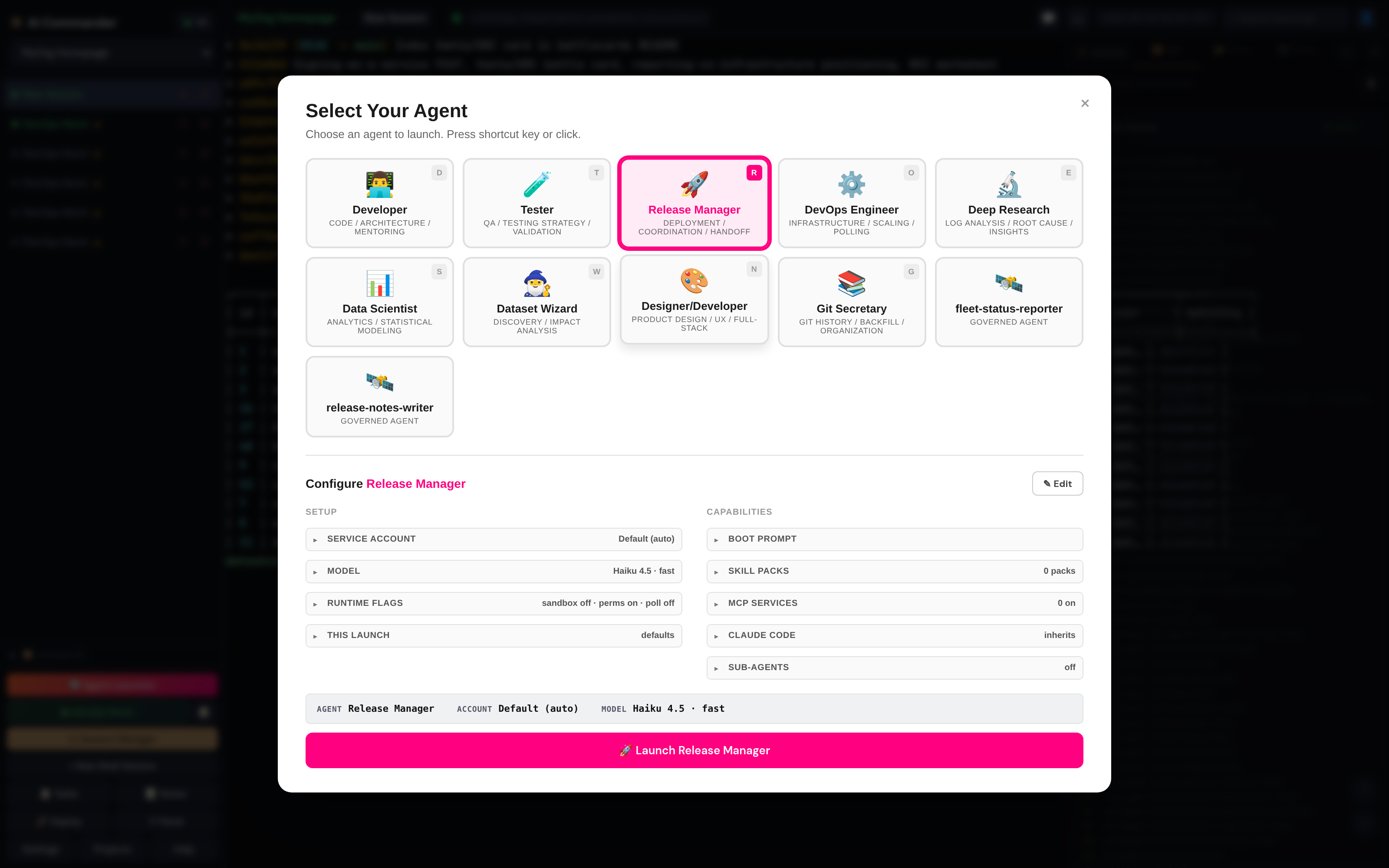
Personas, not prompts in a text file
Pick a persona, see exactly what it boots with, launch. Model, effort, boot prompt, skill packs, MCP servers and the sub-agent gate are all on screen before the first token is spent.
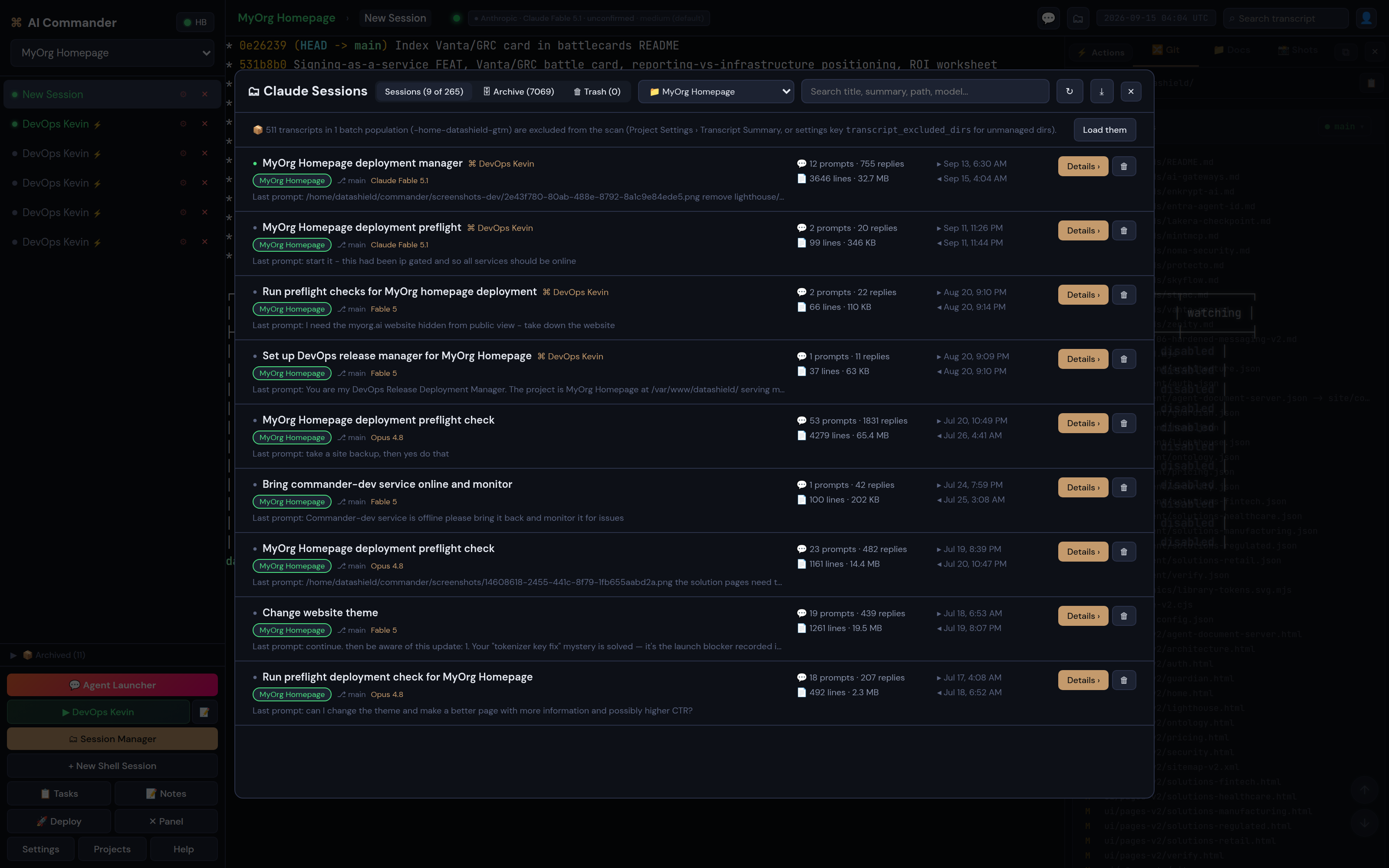
Every session, kept
Logged Claude sessions per project, with prompt counts, transcript size and the persona that ran them. Reopen the conversation or read the transcript without poking the live terminal.
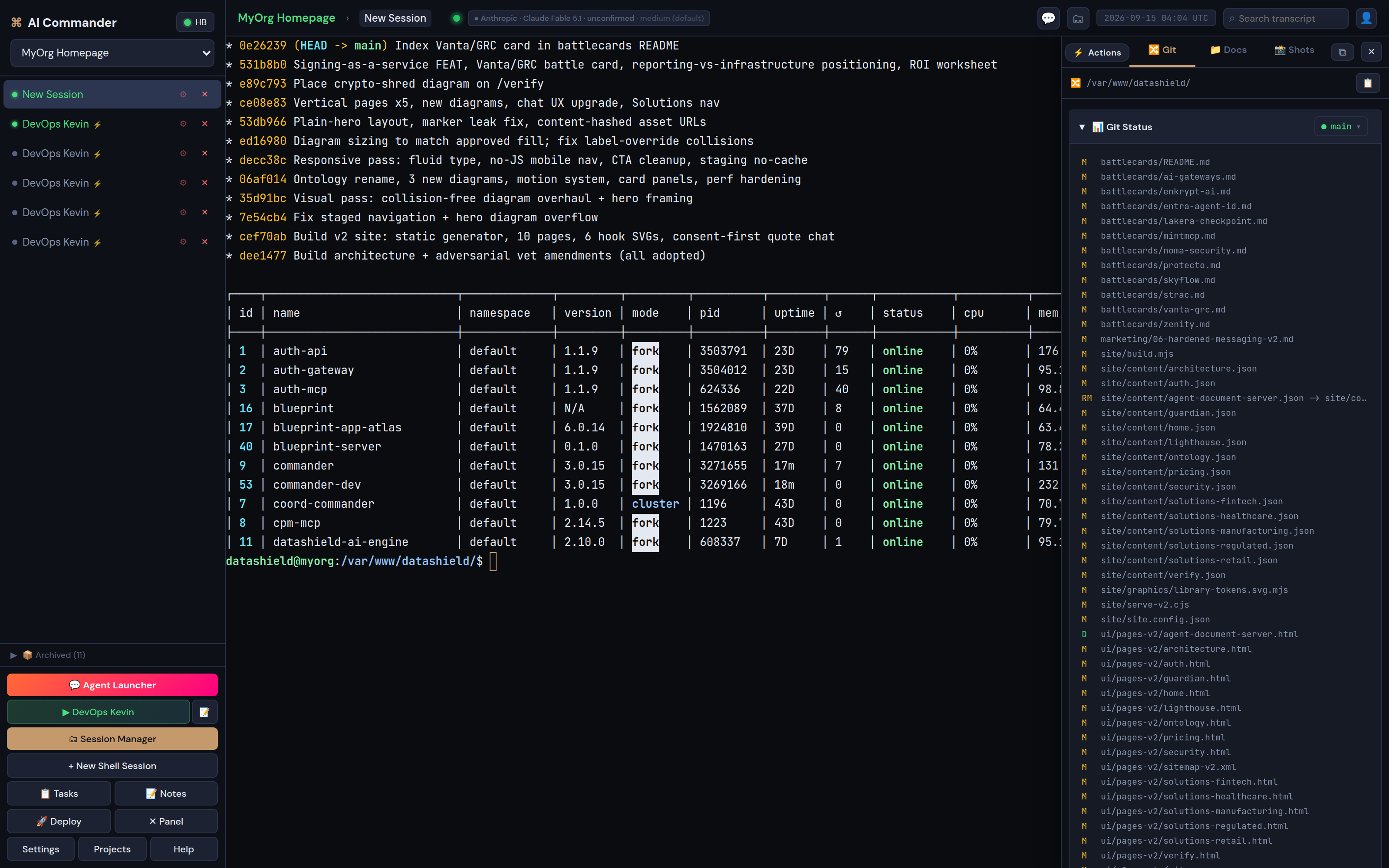
The tree the agent is editing
Working-tree status and a file browser next to the terminal, so you can see what changed before you believe the summary. Commit history and a branch list with worktree collision flags live in the same panel.
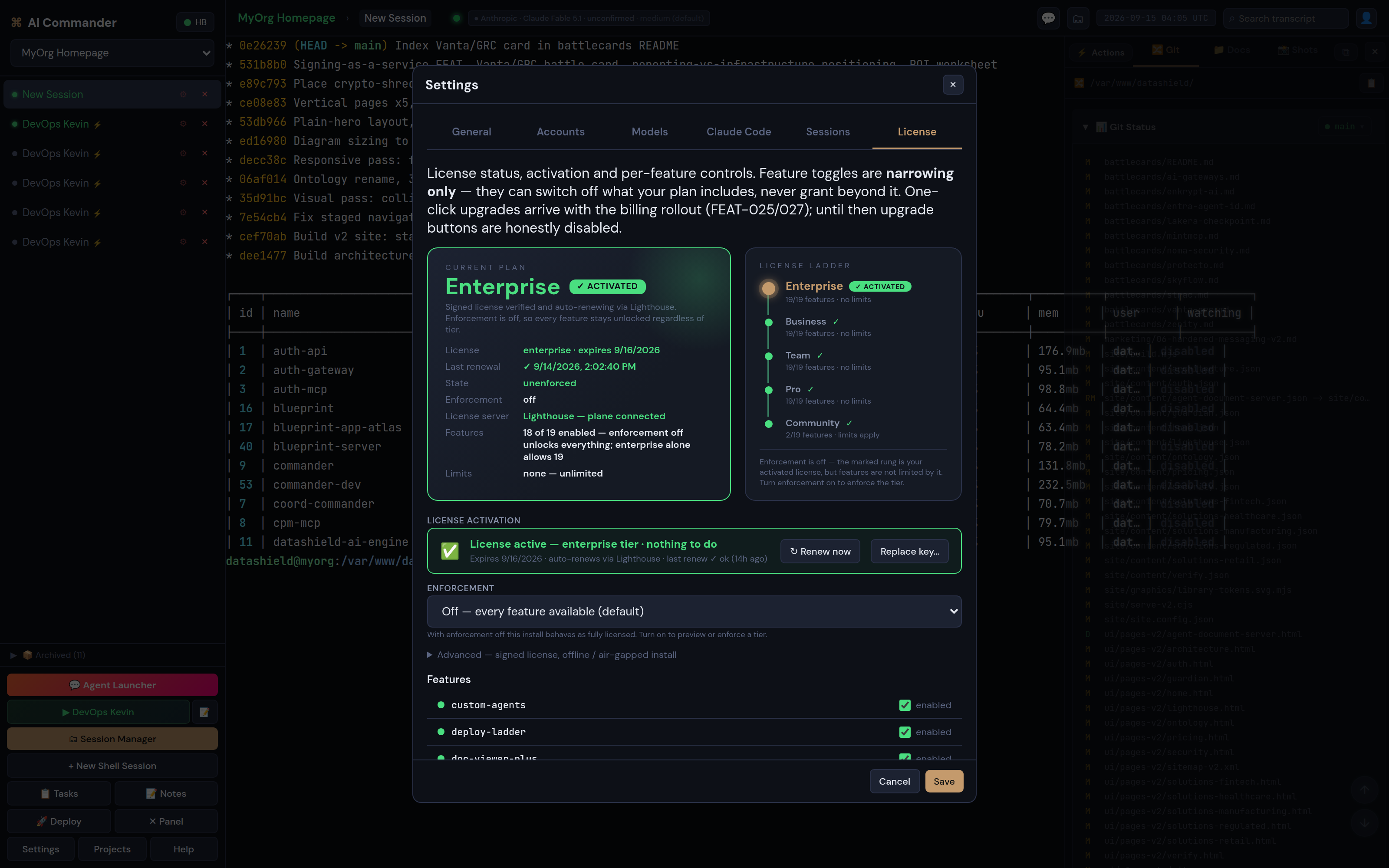
Signed plan, narrowing toggles
Features light up from a signed license. The toggles here can only narrow what the plan grants, never widen it. Same entitlement vocabulary on every surface, so there is no secret door.
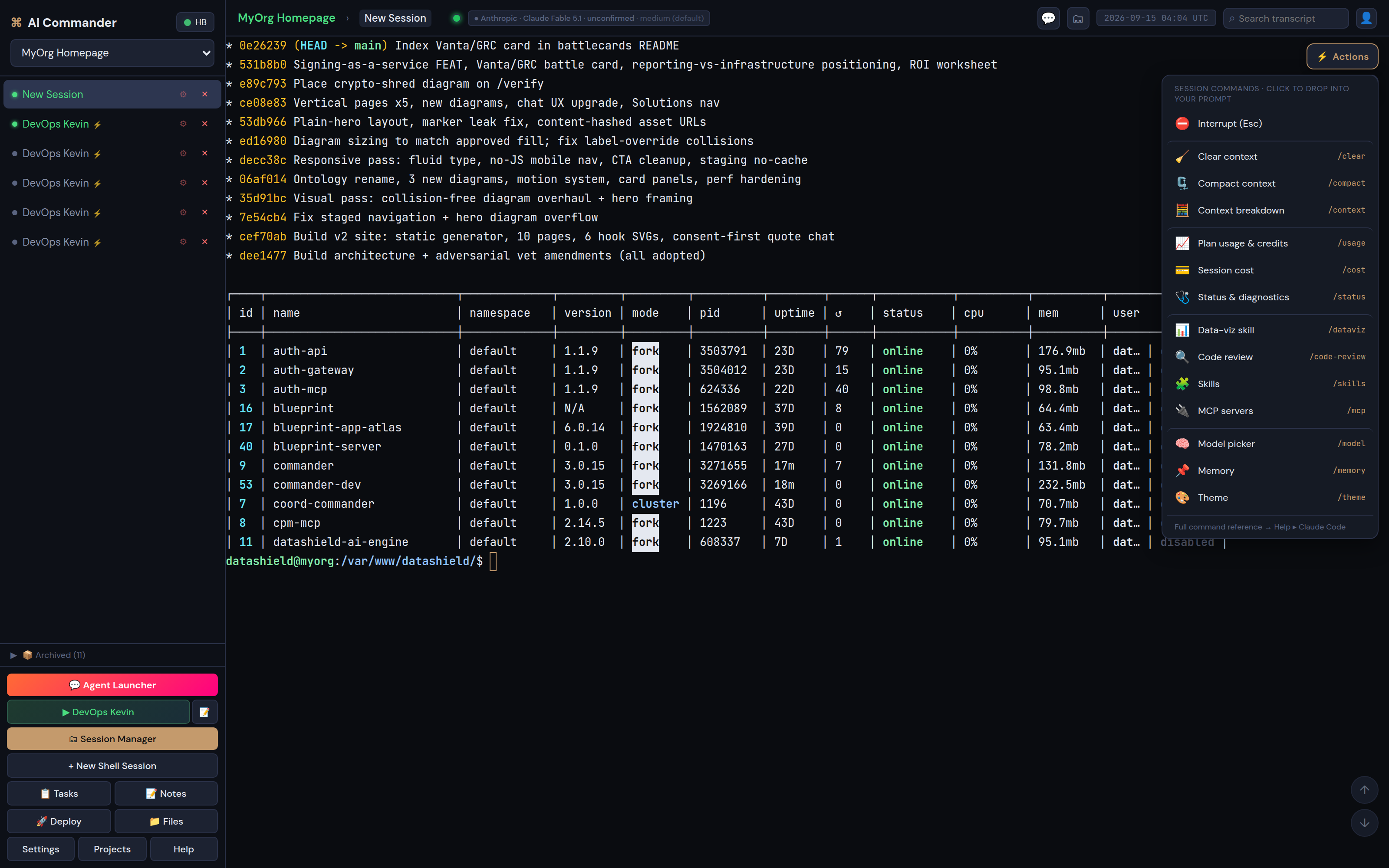
Claude Code commands, one click away
Interrupt, compact, check plan usage, run a code review, switch model. Each action drops the command into the agent's prompt, so nobody has to remember whether it was /cost or /usage.
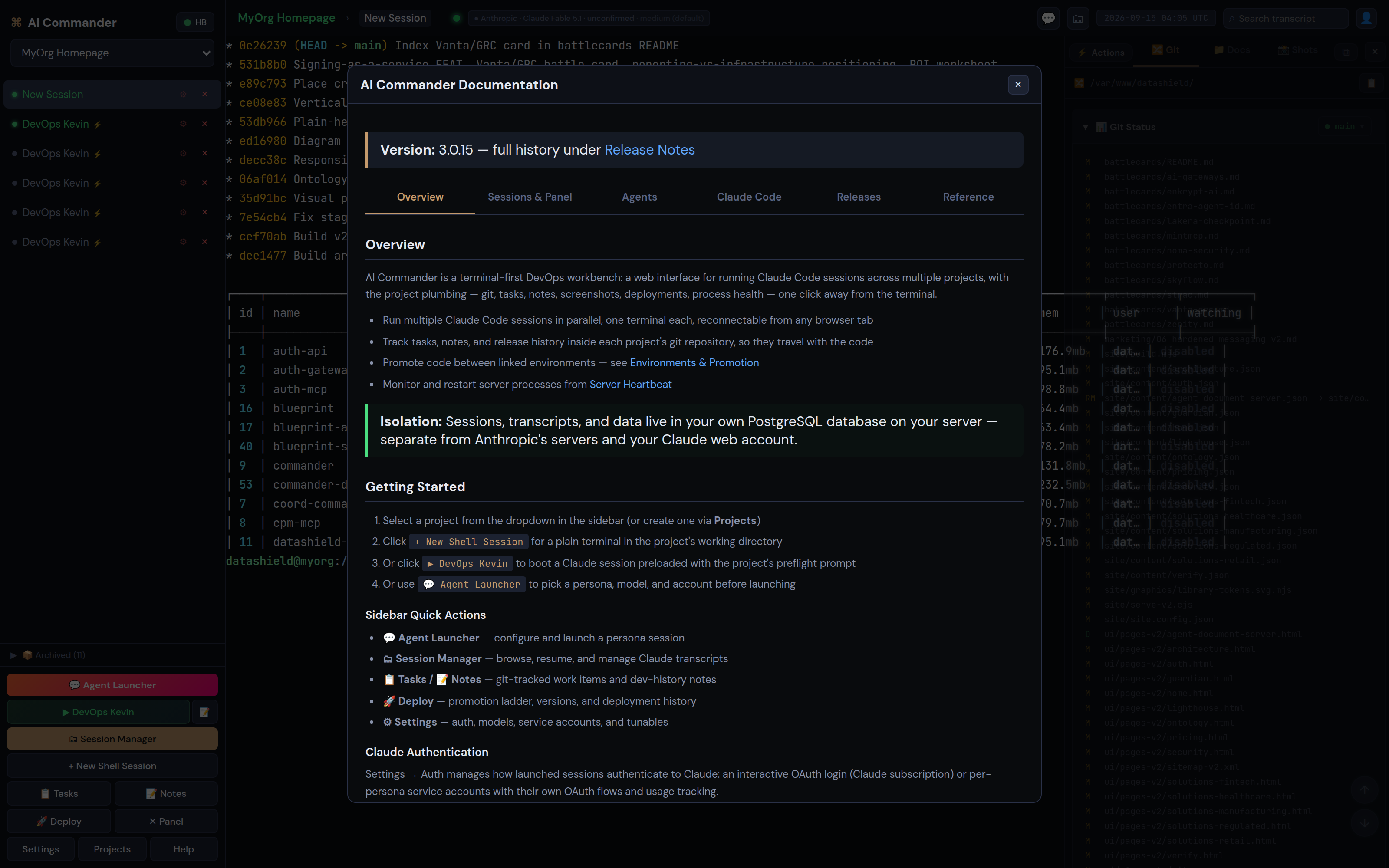
Docs that ship with the build
Versioned in-app docs cover sessions, agents, the ladder and Claude Code auth. Our favourite line is the isolation note: your data lives in your database, on your server. Full stop.
Underneath the cockpit
The parts you only notice when they are missing.
Project and work tracking
Each project points at a git tracking repo: bugs, features, releases and session updates as plain markdown, because markdown does not need a login. A boot-sequence viewer hands agents the same context a new engineer would read on day one, and commit detail opens any change in one click.
Accounts and credentials
Several Anthropic accounts side by side, OAuth or API key, chosen per persona and shown on every session. Third-party credentials sit in an encrypted store, masked by default, with a health probe that finds the dead token before an agent does.
Screenshots and artifacts
Paste a screenshot into a session and it is filed against the project, with an annotation tool whose circles and arrows bake into the PNG. Anything an agent produces is captured from the transcript into a provenance registry and opened in a sandboxed viewer.
Process monitoring
A server tile with real CPU utilization and hypervisor steal, plus status for every process the stack runs, PM2 or systemd. Start, stop and restart go through a validated command list. There is no free-form shell hiding behind a button.
MCP, brokered not held
Personas bind to the MCP servers they are entitled to, and Commander injects the binding at launch. The catalog, credentials and entitlements stay with Auth. Commander never holds a raw MCP key, which is the kind of sentence you want to be able to say in an audit.
Configuration, not code
Every tunable travels one chain: environment variable, settings table, client config. The server is the authority; the browser renders what it is served and hardcodes nothing. That is why a Claude Code version skew shows up as a plain-language toast instead of a silent 3 a.m. failure.
Building something to sell on Commander? That is Enterprise, and it ships through us.
Free, Personal and Team are for running your own agents on your own work. The moment somebody else pays for what Commander runs or produces, that is commercial use. A SaaS tool built on it. A hosted agent you sell seats to. An agency delivering client work through it. All three are commercial, and all three run on Enterprise terms.
Enterprise terms are simple. Commercial products built on Commander ship on the DataShield plane: white-labelled hosting under your brand, the signed license plane that lights up features for your customers, process supervision and fleet state for every instance you sell, and Auth so each customer's agents leave an evidence chain you can hand them. You build the product. We run the parts nobody thanks you for, at industry-standard publishing and hosting rates.
Products built this way are listed on the DataShield marketplace, where companies and individuals subscribe directly. You set the price. We take the platform fee. Licensing and hosting are already solved, because they are the same plane the product was built on. Cheaper to start, longer to pay off, and no second vendor to onboard when the thing works.
Where Commander sits in the DataShield stack
Commander is the operator's seat. Auth is the authority: it signs the license that lights up Commander's features and it owns the MCP entitlements a persona can use. Ontology is the data plane those agents work against, and Corpus serves the documentation, agent definitions and skills they load.
Commander also publishes a signed manifest of the agents it runs, which Auth pulls and governs. That manifest is signed with its own key, deliberately separate from the key that signs deployments. An agent roster and a release are different trust decisions, and we keep them apart.
Plan enforcement is shipped and switched off by default while early deployments settle. Every plan feature is visible today. The gate exists for the day you want it shut.
Questions operators ask first
Where do sessions and transcripts live?
In a PostgreSQL database on the server that runs Commander. Not on Anthropic's servers, not in a personal Claude web account, and not with us. The only thing that leaves the building is the API call to the model.
Is it only for Claude Code?
Claude Code is the first-class provider today, including attach-to-daemon sessions and the command menu. Other providers still work but have not had the same love, and we would rather tell you that than sell you a checkbox.
How does it stop an agent from promoting broken code?
The ladder is server-side and per project. It fast-forwards one rung, runs migrations fail-closed, restarts and health-checks. A dirty working tree halts it. If an operator overrides, the reason is mandatory and the override is written to deployment history as its own audited step. A dirty file that the promotion would also change can never be overridden.
Can I run it on my own hardware?
Yes. Commander is self-hosted in your own cloud or data center, or on a dedicated single-tenant server we operate for you. It needs Node, PostgreSQL and a route to the model provider. There is no multi-tenant SaaS and no shared control plane.
What happens when Claude Code ships a breaking change?
Commander pins the behaviours it depends on and watches session output for the known skew signatures, so a CLI that is too old for a model or refuses a resume shows up as a plain-language toast, not a cryptic one-liner. When a Claude Code release flipped a trust dialog to default to exit, the fix shipped the same week. It is in the release notes, with the swearing removed.
Can agents launch their own sub-agents?
Only if you allow it per persona. Two flags decide who may be a sub-agent and who may use them, both off by default. Sub-agents cannot spawn sub-agents. The Agent tool is denied one level down, without exception, because we have all seen what happens otherwise.
What counts as commercial use?
Anyone paying for something Commander runs or produces. A SaaS product built on it, a hosted agent you sell access to, or an agency delivering client work through it. Agency use is commercial use. Building your own company's software with it is internal use, and that is what Personal and Team are for.
Do I need to host with you?
For your own use, no. Docker editions run wherever you like, and DataShield-provisioned means a dedicated single-tenant server we operate for you. For commercial products, yes. They ship on the white-labelled DataShield plane, and that is the deal.
What does the Free edition leave out?
It is the same product, capped at one project and two concurrent sessions, with built-in personas only and no promotion ladder. It is for finding out whether a cockpit changes how you work. When it does, Personal removes the caps and you can stop closing tabs to make room.
Commander v3.0.15 — in production. Runs alongside Auth, Ontology and Corpus.
See your own agents in the cockpit. A quote takes a minute. A walkthrough takes twenty.
Get an instant quoteYou've seen the proof
Ready for a number? Scope your deployment and we'll price it against your own economics.
Get your quote →